


Akshaura AIRAsset Intervention Reasoning
Structured reasoning that turns asset evidence into funded interventionsInterventionAn action on an asset, such as a repair, upgrade, replacement or retirement., at scale

Know what to do next. And when.

From chillers and machinery to servers and software, your business depends on assets. AIR helps your teams decide what attention and investment each asset needs and when.
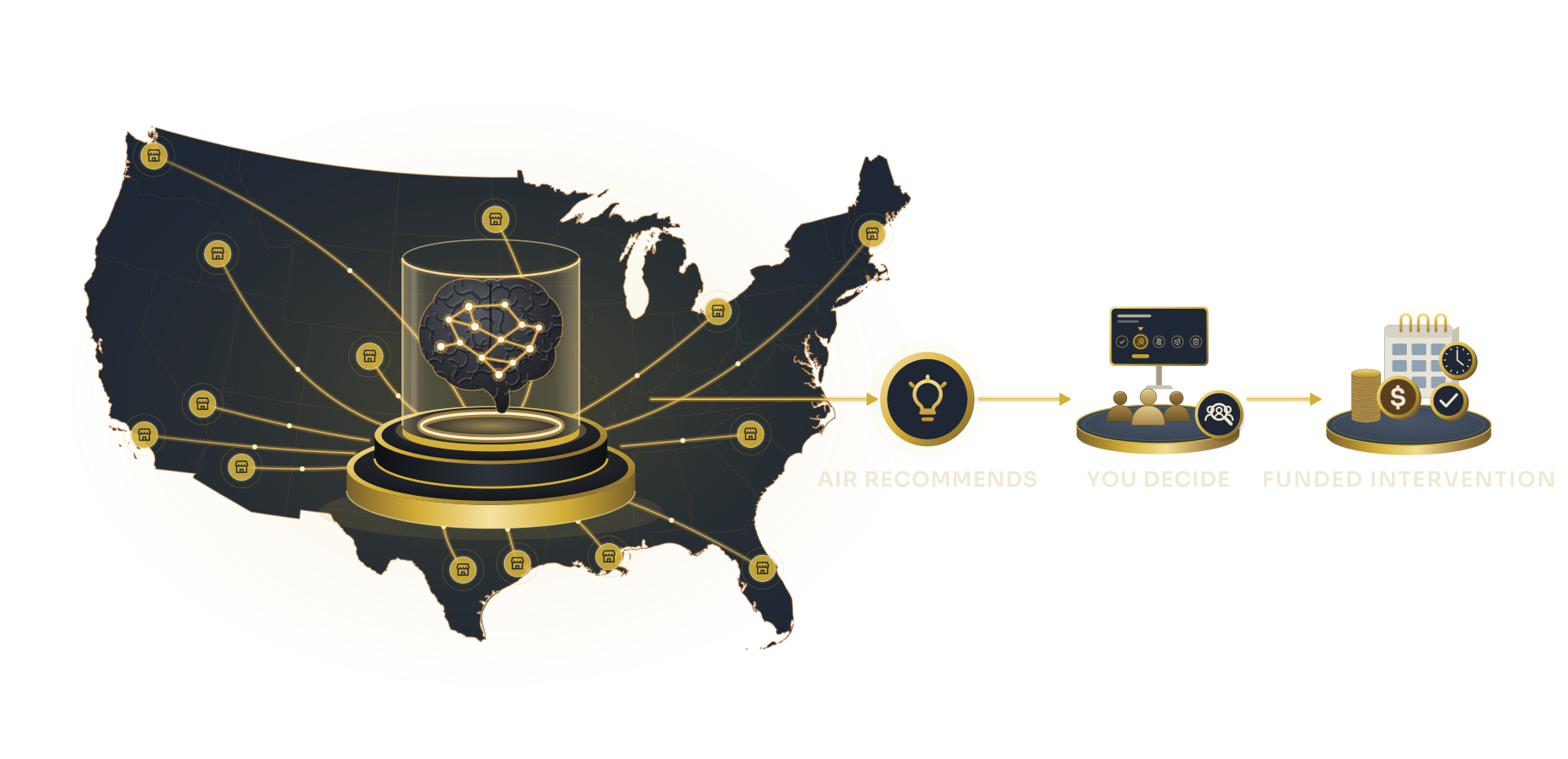
Conceptual illustration: asset evidence across many locations flows into AIR reasoning. AIR recommends, you decide, and the result is a funded intervention.
AIR ReasoningWeighs asset evidence, business context and risk to recommend an intervention.See how AIR reasons
AIR recommendsA recommendation with its evidence, alternatives and stated confidence.See a sample recommendation
You decideAccept it, change it, or ask for a second look. Authorize the next steps through your approval process.See how you decide
Funded interventionTrack the funded work through to closure in AIR Planning.Track funded work

Conceptual illustration. No customer footprint is implied.

AIR recommends, you decide.
  1. 1AIR reasonsWeighs evidence beyond a single asset
  2. 2AIR recommendsSee a sample recommendation
  3. 3You decideAccept, change or ask for a second look
  4. 4Funded interventionTrack it in AIR Planning

What does AIR do?

Over time, assets need attention as their condition, performance, support, and business requirements change. Deciding what to keep, repair, upgrade, replace, or retire—and when—is difficult when the information is scattered.

  1. 1

    AIR reviews

    Combines asset evidence, business priorities and capital planning to spot what needs attention.

  2. 2

    AIR recommends

    Recommends the best action, shows the alternatives it weighed, explains why, and states how confident it is.

  3. 3

    You decide

    Accept it, change it, or ask for a second look. Authorize the next steps through your approval process. AIR then tracks the plan to closure.

What you get

One decision-ready brief for every asset.

One aging asset is more than a repair-or-replace question. Recurring faults raise reliability concerns. Operations needs the product kept cold. Finance needs a justified capital request. The business wants supportable, standardized equipment.

AIR brings those considerations together and explains the recommended path. Open the evidence to see what it found and how it shaped the recommendation.

Asset and locationRefrigerated case RC-0214 · Store 014 Illustrative example
Recommended intervention

Begin replacement planning now.

Use a targeted repair as an interim measure if inspection confirms continued operation is appropriate and product stays protected.

Rationale
  • Repairs are not holding. Four in 14 months.
  • Comparable assets failed. Similar units across locations showed the same recurring faults before failure.
  • Support is winding down. The manufacturer has limited parts for this model.
Confidence
Timing

Start planning now. Work backward from when the work needs to be complete, allowing for approvals, work lead time, and the replacement budget cycle.

What could change it

Inspection findings, supplier quotes, and confirmed lead times could change the choice or timing.

See the evidence behind this recommendation
What it foundFour compressor repairs in 14 months.Each repair restored cooling only for a short time, and case temperatures drifted above target at two inspections.
How it shaped the recommendationRepeated repairs add cost without lasting reliability, so another repair on its own is a weak choice.

Hypothetical findings for demonstration. No customer result or equipment-specific claim is implied.

The asset decision gap

Different priorities. Fragmented evidence. One asset decision to make.

Maintenance, operations, finance, and technology each bring a valid perspective. The challenge is evaluating them together, across locations, before urgency narrows the options.

Reliability

Maintenance

Keep the equipment dependable.

Discipline

Finance

Make every investment defensible.

Continuity

Operations

Protect operations and customer experience.

Direction

Technology

Move toward supportable, modern assets.

One asset decisionEvaluated together, across locations
Meet

Ask about your assets, recommendations, and plans.

aura is the AI assistant in Akshaura AIR. Ask in plain language and explore answers grounded in your asset records, recommendations, and plans.

The platformAIRReasons over your asset evidence and recommends
Your AI assistantAsk in plain language
Your AI assistant for AIR
Illustrative

Try asking

Plan ahead

“Which stores have refrigerated cases we should plan to replace before next year’s budget?”

AIR recommends starting replacement planning now for refrigerated cases at three stores: Store 014, Store 027 and Store 063. Store 014 (RC-0214) is the most time-sensitive, with the budget window approaching.

Want to see the evidence and the confidence behind each one?

Understand

“Why is this case recommended for replacement?”

Illustrative questions. You review, change and decide.

Built for multi-location enterprises

Connect asset decisions to operational continuity and capital plans.

Bring facilities, operations, and finance into the same conversation, wherever your assets operate.

Facilities & Maintenance

Evaluate which assets need attention, which intervention fits, and what evidence supports it.

Finance & Capital Planning

Trace proposed investment to asset needs, rationale, anticipated timing, and budget periods.

Operations & Site Leadership

Plan around operating priorities, installation requirements, and the consequences of disruption.

The Platform

From asset context to a governed plan.

Explore the Platform
01 / AIR REGISTRY

Know Your Assets

One trusted record for every asset.

02 / AIR REASONING

Anticipate & Recommend

Spot trouble early and suggest the best action.

03 / AIR PLANNING

Intervene & Fund

Turn the decision into a funded, approved plan.

04 / AIR REGISTRY + AIR PLANNING

Track to Closure

See the work through to the end and keep a record of the result.

Future direction · AIR Continuum. Longer term, AIR Continuum will calibrate reasoning to each enterprise’s recorded outcomes. It is not part of the live cycle today.

Built for accountable decisions

  • You decideEvery recommendation goes through your approval process.
  • ExplainedAlternatives, reasons and trade-offs are shown.
  • Confidence statedAnd what could change the answer.
  • Examples labelledIllustrations are marked and never imply a customer result.
Next step

What should your teams plan for next?

Bring a real asset decision or your next capital planning challenge. Let’s examine the evidence and a practical place to begin.

Akshaura AIRAsset Intervention Reasoning
Structured reasoning that turns asset evidence into funded interventions, at scale

Evidence becomes a recommendation. A recommendation becomes a plan.

AIR Registry, AIR Reasoning, and AIR Planning connect asset context, intervention choices, capital budgeting, and follow-through at scale.

One connected process

One loop, from asset knowledge to closure.

Four live stages carry an asset decision from context to a closed-out intervention. Select a stage to see more.
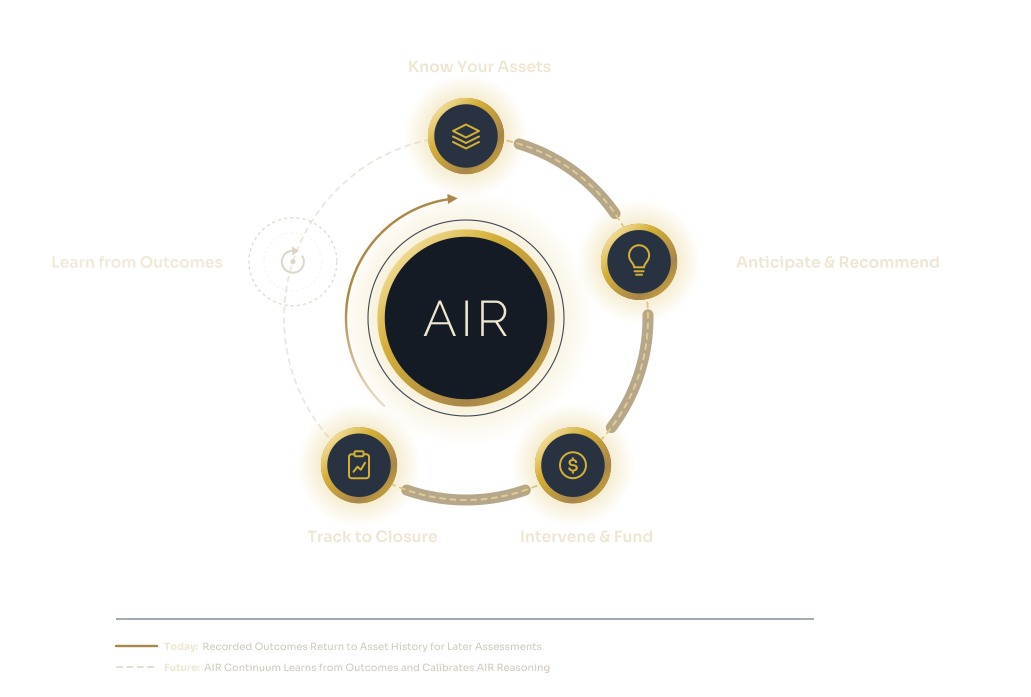
STAGE 1Know Your AssetsOne trusted record for every asset.AIR Registry
STAGE 2Anticipate & RecommendSpot trouble early and suggest the best action.AIR Reasoning
STAGE 3Intervene & FundTurn the decision into a funded, approved plan.AIR Planning
STAGE 4Track to ClosureSee the work through to the end and keep a record of the result.Registry + Planning
LONG-TERMLearn from OutcomesAIR Continuum
The AIR loop: 1 Know Your Assets (AIR Registry), 2 Anticipate and Recommend (AIR Reasoning), 3 Intervene and Fund (AIR Planning), 4 Track to Closure (AIR Registry and AIR Planning), and 5 Learn from Outcomes (AIR Continuum, long-term). Select a stage to see more.0102030405
01 / Know Your Assets

Know Your Assets

AIR Registry

Connect identity, location, lifecycle, and service context in a shared asset record.

Today, recorded outcomes become part of asset history for later assessments. Enterprise-specific calibration is a long-term goal and is distinct from recording intervention outcomes in asset history today.

Three core modules

Shared context. Clear responsibilities.

01
Know

AIR Registry

A shared asset record and lifecycle context for the decisions ahead.

  • Asset identity, classification, location, attributes, and relationships.
  • Maintenance schedules and service history where maintenance is managed in AIR.
  • Asset lifecycle events, including service, repair, replacement, retirement, and disposal.
  • Context linked to recommendations, plans, and recorded outcomes.
02
Anticipate & Recommend

AIR Reasoning

Purpose-built AI reasoning grounded in structured assessment and broader evidence.

  • Assess physical, financial, operational, and strategic risks using a common framework configured to your asset classes and policies.
  • Examine asset history, comparable equipment across locations, and current make-and-model information from trusted sources.
  • Evaluate retain, repair, refurbish, replace, and retire against priorities, policies, and constraints.
  • Explain recommendations, alternatives, trade-offs, anticipated timing, and stated confidence.
03
Intervene & Fund

AIR Planning

Carry the decision into a justified plan, capital budget preparation, and applicable approvals.

  • Define intervention scope, resources, timing, and proposed spending.
  • Allocate spending to budget periods and obtain required funding and approvals.
  • Coordinate authorized next steps and execution handoff with connected systems.
  • Track progress through closure, with lifecycle events and outcomes linked to the asset.
Your AI assistant

Ask about your assets, recommendations, and plans.

aura is the AI assistant in Akshaura AIR. Ask in plain language and explore answers grounded in your asset records, recommendations, and plans.

Find

  • “Which stores have refrigerated cases we should plan to replace before next year’s budget?”
  • “Which recommendations are still waiting for a decision?”

Understand

  • “Why is this case recommended for replacement?”
  • “How confident is AIR, and what could change the recommendation?”

Check timing and status

  • “When should we start planning this replacement?”
  • “Which plans are waiting for funding or approval?”
Draft with aura
“Draft a replacement plan for these cases for my review.”

aura prepares the draft. You review it, change it and decide before anything moves forward.

Ask aurain plain language
Work in AIRbrowse assets, act on recommendations, manage funding and approvals, and track progress

Illustrative questions. aura helps you find, understand and draft. You review, change and decide.

Early enough to plan

Work backward from when intervention may be needed.

AIR Reasoning is designed to recommend as soon as the available evidence supports planning. It states when the work needs to be complete and when planning should begin.

Decision & approval time

Time to decide, secure funding and approvals, and issue the approved order or authorization.

Work lead time

The time needed to complete the intervention, such as to procure, schedule, and install or finish the work.

Replacement budget cycle

The relevant funding calendar for replacement requests.

Stated timing confidence

Evidence and assumptions that may change the projection.

Planning parameters are set with each organization. Timing is a projection, not a guarantee, and is reevaluated as evidence changes. Urgent interventions still require action.

You decide. Governed follow-through.

Funding, where needed, and approvals come before execution handoff.

Act on the Recommendation

Prepare the Plan

Fund & Approve

Coordinate Authorized Work

Track to Closure

You review, accept, override, or request reassessment. Where available funding falls short, AIR raises the funding request; where approvals are required, AIR builds the approval chain and routes it. Funding and approval processes follow your organization’s rules and connected systems. Your people authorize the next steps through your approval process, and AIR tracks the plan to closure.

WORK ALONGSIDE

Work alongside the systems you keep.

Use AIR Registry and AIR Planning, or retain existing asset records and bring AIR in for intervention reasoning and coordination. Connections use AIR’s APIs or prepared data.

FIT

Define the fit before connecting.

Agree which system owns each record, what information is exchanged, and where execution stays. Integration scope is defined for each deployment in a Data Integration Review.

AIR CONTINUUM · LONG-TERM

Learning from outcomes.

Calibrate reasoning to each enterprise’s recorded outcomes and propose policy and constraint updates for enterprise approval. This is a future direction, not a current calibration capability.

Next step

See how AIR could fit your workflow.

Bring your existing systems, approval process, and planning challenge. We’ll define a practical starting point together.

Why AIR

A broader assessment. A better-supported choice.

AIR Reasoning brings structure to intervention decisions that span competing priorities, uncertain evidence, and many locations.

Why AIR
01
Full business context

The asset’s condition is part of the decision.

The right intervention also depends on financial exposure, operational importance, and where the business is heading. Weigh physical, financial, operational, and strategic risks together.

Physical

Condition, performance, reliability, and age.

Financial

Repair costs, downtime exposure, and operating-cost implications.

Operational

Criticality, continuity, safety, compliance, and customer impact.

Strategic

Supportability, modernization, sustainability, and business direction.

02
Evidence beyond the single asset

Broaden the evidence behind the recommendation.

Experience elsewhere and newly available information can change which intervention makes sense.

This asset

Maintenance, repair, inspection, lifecycle, and condition history.

Comparable equipment

Relevant experience with similar assets across locations, matched to the decision context.

Make & model

Current, relevant information from trusted external sources, such as manufacturer guidance and support information.

03
Explainable, with stated confidence

A recommendation your teams can examine.

AIR compares intervention choices against your priorities, policies, and constraints. It explains the trade-offs and what could change the answer.

The recommended action

What AIR recommends and why it fits the available evidence.

Alternatives & trade-offs

What other options offer, what they leave unresolved, and what choosing the recommendation means.

Timing & stated confidence

When intervention may be needed, when planning should begin, and the assumptions and missing evidence that matter.

Confidence communicates uncertainty. It is not a guarantee that an outcome will occur.
Ask

“Why is this unit recommended for replacement?”

Ask aura what evidence supports the recommendation, which alternatives AIR considered, and what could change the recommendation.

04
Consistency across locations

Two similar assets. Two different interventions.

AIR applies a common assessment framework, configured to your asset classes and policies. Because each store brings its own evidence, importance to operations and constraints, similar assets can fairly warrant different interventions.

Store 014 · Refrigerated case · 12 years old
  • PhysicalFour compressor repairs in 14 months
  • FinancialRepair costs rising each year
  • OperationalHigh-volume fresh department
  • StrategicSupport for the model is winding down
InterventionReplace. Begin planning now.
Store 087 · Refrigerated case · 12 years old
  • PhysicalOne routine repair in three years
  • FinancialLow repair cost, steady performance
  • OperationalLow-volume; stock can be moved if needed
  • StrategicModel still fully supported
InterventionRetain and monitor. Reassess at the next review.
Same reasoning approach at every locationPhysical · Financial · Operational · Strategic
Facilities, operations, and finance can compare upcoming needs on a common basis and connect proposed interventions to relevant budget periods.

Hypothetical stores for illustration only. No customer result is implied.

Why timing matters

Early Evidence · Late Decisions · Fewer Options

Act while the options are still open.

Early evidence is useful only if it reaches the planning conversation in time. Delayed decisions can leave less room to compare alternatives, secure funding, procure equipment, and schedule the work.

THE WINDOW TO PLAN NARROWS OVER TIME As the window closes, alternatives, funding, and procurement and scheduling get compressed, which may negatively affect the business. Compare alternativesSecure fundingProcure & schedule Budget cycleDecision & approval timeWork lead time Evidence availableWork complete Conceptual illustration. Timing is a projection, not a guarantee.

The window to plan narrows over time

Compare alternatives
Secure funding
Procure & schedule
Work complete

As the window closes, alternatives, funding, and procurement and scheduling get compressed, which may negatively affect the business.

01 / BEFORE BUDGETS ARE COMMITTED

Bring needs into the funding conversation.

Connect anticipated replacements to the relevant budget cycle while there is time to prepare a justified request.

02 / BEFORE LEAD TIMES LIMIT CHOICE

Leave room to complete the work.

Account for decision and approval time and the work lead time to procure, schedule, install or complete the intervention.

03 / BEFORE AN ISSUE BECOMES URGENT

Compare the relevant alternatives.

Where evidence supports planning, evaluate retain, repair, refurbish, replace, or retire before urgency narrows what is feasible.

As your next budget cycle approaches, can your teams explain which assets need investment, when, and why?

AIR is designed to support earlier planning where the evidence allows. Urgent interventions still require action.

Why act now

Three generations of asset systems. From records and insights to reasoned action.

Each generation answered a bigger question. Records gave visibility. Intelligence gave insight. Reasoning now turns both into decisions.

1First generation

Systems of record

What do we own, and what has happened?

Asset registries, EAM, CMMS

Focus: Visibility
2Second generation

Systems of intelligence

What is happening, and where is it heading?

Monitoring, IoT, analytics, APM

Focus: Insight
3Emerging now

Systems of reasoning

What should we do next, and when?

Asset reasoning, such as Akshaura AIR

Focus: Better-supported decisions

Each generation builds on the one before. Reasoning does not replace your records or intelligence. It depends on them. Most organizations already hold the foundation. The missing step is deciding.

Value to evaluate on your data

Better decisions should have measurable value.

Value comes from avoided costs and losses, preserved asset life, and staff time freed. Each benefit is counted once.

Costs avoidedAvoidable repair costsRepairs that a different intervention choice could have avoided, including the extra cost of emergency repairs the evidence could have anticipated. Necessary interim repairs and warranty reimbursements are excluded.
Costs avoidedAvoidable emergency replacement costsThe premium paid over the regular cost of replacements that could reasonably have been anticipated and planned.
Losses avoidedAvoidable outage lossesLost margin, lost inventory and extra response labor from outages that the evidence could have anticipated.
Asset value preservedLonger useful lifeUsable service life preserved when the evidence supports keeping an asset in service longer.
Capacity freedStaff time freedDecision preparation time freed and valued as capacity. It is not a cash saving or a headcount claim.

The detailed calculations live in the business case tool, built on your own records, costs and assumptions.

Supporting outcomes, outside the ROI: Better Capital Allocation · Earlier Budget Visibility · Lower Operating Costs

Next step

Test the difference on a real decision.

Use a working session or a focused pilot to evaluate recommendation usefulness, evidence, timing, confidence, and workflow fit.

Resources

Understand the asset decision gap. Explore the role of reasoning.

Start with the customer whitepaper on structured reasoning for asset intervention decisions.

Akshaura AIR
AKSHAURA / PERSPECTIVESThe Emergence of Asset ReasoningFrom asset information to intervention decisions.
Featured whitepaper · Customer edition

The Emergence of Asset Reasoning

Explore why asset decisions need more than records and insights, and how structured reasoning can connect evidence, business priorities, and intervention planning.

  • ◆  The asset decision gap across teams and locations.
  • ◆  Full-context assessment and evidence beyond the individual asset.
  • ◆  Explainable recommendations, confidence, and the final decision staying with you.

One short form. We email the whitepaper to you.

Request the customer whitepaper

A closer look at asset reasoning.

Leave your email to request The Emergence of Asset Reasoning. It will be delivered by email.

The request is for this whitepaper. It does not subscribe you to marketing updates.

Where should we send it?

Request received

Questions in the meantime? Write to info@akshaura.com.

The resource library

Perspectives and practical guidance.

Articles and blog posts will be readable here on the site once published. Whitepapers are delivered by email. The items below are upcoming placeholders.

Article · 01 · DECISION PRACTICEUpcoming

Weighing repair, refurbishment, and replacement

Planned topic: evaluating intervention choices in the context of business priorities and available evidence.

Will be readable here once published
Blog · 02 · A PERSPECTIVE ON ASSETSUpcoming

What does confidence add to a recommendation?

Planned topic: using uncertainty and missing evidence to decide when to act or seek more information.

Will be readable here once published
Whitepaper · 03 · CAPITAL PLANNINGUpcoming

From asset evidence to capital planning

Planned topic: connecting anticipated intervention needs to budget periods, funding requests, and approval processes.

Will be available by email once published

Placeholders show the planned library. No article, blog post, or additional whitepaper has been published yet.

Next step

What does asset reasoning mean for your business?

Bring an intervention or capital planning question. We’ll explore it together.

About Akshaura

Technology should improve the decisions it enables.

Akshaura connects asset information and business priorities so enterprises can choose, explain, and act on the right interventions at scale.

Structured reasoning that turns asset evidence into funded interventions, at scale
Our purpose

Close the gap between knowing and deciding.

Enterprises know a great deal about their assets. Turning that information into a shared intervention decision still requires teams to reconcile priorities, assemble evidence, and justify funding.

We are building Akshaura AIR to connect that work: a shared asset context, structured reasoning, and governed plans. Our focus is enterprises managing physical and digital assets across many locations, where asset decisions connect operational needs, investment, and strategic direction.

AIR· the platform
aura· AI assistant for AIR
Our vision

A future where enterprises understand their assets in the context of the business and make confident, evidence-driven decisions at scale, supporting operations, investment, and strategic direction.

Our mission

Connect asset information with business priorities through AI grounded in structured reasoning and relevant evidence beyond the individual asset, helping enterprises choose, explain, and act on the right interventions at scale.

Our guiding principle
Great technology is not measured by its sophistication; it is measured by the quality of the decisions it enables.
Next step

Let’s work on the decision behind the asset.

Tell us what your teams are weighing and where the process gets difficult.

Let’s Talk

Start with a real asset decision. Leave with a clear next step.

Tell us about your assets, how you make intervention decisions, and the planning challenge you want to address.

Understand your challenge

Discuss the assets, locations, recurring decisions, and business priorities involved.

Explore the fit

Review where AIR could help and what evidence or existing systems would shape the approach.

Agree a useful next step

Optionally add a workshop, working session, integration review, or focused pilot.

Facilities, operations, and finance perspectives are useful. You can begin with whichever team owns the immediate challenge.

Tell us a little about yourself.

Enquiry sent

You can also reach us at info@akshaura.com.

Before we talk

A few practical questions.

Does AIR replace our existing systems?
AIR works alongside the systems you keep. Adopt AIR Registry and AIR Planning, or retain your existing asset records and use AIR for intervention reasoning and coordination. Integration scope and record authority are defined with you.
How early can AIR recommend an intervention?
AIR is designed to recommend as soon as the available evidence supports planning. It works backward from when the work needs to be complete, using your decision and approval time, work lead time, and the replacement budget cycle. Each projection has stated confidence and is reevaluated as evidence changes. Timing is a projection, not a guarantee.
Who makes the final decision?
You do. AIR recommends. You accept, override, or request reassessment. Your people then authorize the next steps through your approval process, with AIR routing any funding and approval requests, and AIR tracks the plan to closure.
What is aura?
aura is the AI assistant for AIR. You can ask it to find assets that need attention, explain a recommendation, or tell you which plans are awaiting funding or approval.
What would we need to get started?
Start with an asset category or a real intervention decision. Together, we assess available asset and service records, business context, and the question you want to evaluate. A Business Case Workshop, Working Session, Data Integration Review, or Focused Pilot can provide a practical next step.
Thank you! Your submission has been received!
Oops! Something went wrong while submitting the form.
Thank you! Your submission has been received!
Oops! Something went wrong while submitting the form.